 |
| Camping at Medina |
 It's called Playa Medina, on the peninsula of Paria; it's postcard picture perfect...it is actually the beach most seen in postcard photos in the country. The sand's like white corn flour, the water like the sky above the endless Llanos. It's hemmed in by impassable mountains and fringed by coconut palms, of course. And during the week, the place is empty...all to yourself. Well you can imagine. Paradise.
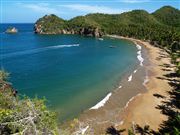 |
| Medina from above |
The beach was only half sandy. The other half included non-sand items such as glass and plastic bottles, dead and rotting fish, dried cow and donkey shit, broken Barbies and other miscellaneous trash, and sea shells (not even the pretty ones, either). The water, well, looked like it came out of a cloaca...I'll spare you the richer description. You can imagine. Not paradise.
 And that was just my first impression. Things got far worse. First things first, we tried to put up the tent, but with 50km/h winds and soft sand mixture, the tent pegs absolutely refused to stay put. One hour later, we were still at it, when one of the others in the group mentioned that they had an extra tent. Yes, please !
Five minutes later, our new tent was up. But comicly enough, the zippers were jammed, and so we were stuck with a gaping opening on one side like a giant frog's mouth . There wasn't much we could do...so we had dinner : pita and veggies. Remember the wind ? Well carrots are whole lot crunchier when eaten in a sandstorm. Pita bread, too. Four days later, I'm still finding grains of sand in my teeth.
 So we went back to the tent. Remember the wind, again ? Well, all evening the wind force fed our sad open-mouthed frog tent with sand like a sadistic Frenchman hoping to eat its liver. And just then Pauline had the best idea ever, even better than either of us realized at the time. She suggested that we take our old tarp-tent and drape it over the new gaping one. Less than a minute and half later, the skies opened up and released one of the hardest and windiest and wettest and longest downpours that we've experienced since arriving in South America. All night long, the tent jumped, shifted, leaned, and moaned. Rainwater slowly filled its corners. From the screams we heard in the night, we could only assume the other campers were a lot wetter than us. From time to time, a tent-peg would come undone and the tent would flap and flail harder than usual, and we (usually Pauline) would have to go out and replant it. And several times, our thoughts transcended from the mental to the verbal : I hate this fucking beach !
But of course, everything was better in the morning. I woke up with the sunrise, my eyes bleary and encrusted with wet sand, but somehow I felt refreshed. The wind had calmed down, and most of the group was also up. We spent the morning swimming, eating sandless food, and chatting in the shade of a flotsam and concrete refuge.
I think in the end, like with all miserable moments, our memories of Zapara will stay vivid with us, provoking laughter whenever we tell the tale. Whereas Playa Medina, with its perfect sand and azure water will fade and blend in among other countless beaches with the same description. So if you ever go to Venezuela´s Caribbean coast, forget Los Roques, Mochima, Morrocoy, or even Medina. Head over to Zapara, where sand is the main ingredient in every meal, and the only fish you'll see are the bloated remains next to your tent.

